
Selling through Amazon, Shopify, eBay, Etsy, TikTok Shop or any combination makes your finances genuinely complicated. Multiple sales channels, marketplace deductions taken before the money reaches you, payout delays, stock purchases weeks before sales arrive, and VAT rules that seem to change every year.
And 2026 has narrowed the margin for error. The National Living Wage and employer National Insurance contributions both increased in April. Making Tax Digital for Income Tax is now live, adding quarterly reporting obligations. There is no room left for sloppy bookkeeping.
Most sellers focus on what’s easy to measure: total revenue, units sold, average order value. These are the numbers every marketplace dashboard puts front and centre — and they’re almost entirely useless for making good financial decisions. The numbers that actually matter are harder to get at. Here are five questions every ecommerce seller should be able to answer — and the right accountant should be helping you answer them.

This is the question that matters most, because profit and cash are completely different things in ecommerce.
Think about the full cycle. You place a £10,000 stock order with an overseas supplier — paying a 30% deposit on day one, the remaining 70% three weeks later when production finishes. Sea freight including customs clearance to a UK Amazon warehouse takes another 35–40 days. FBA check-in and processing adds one to two weeks. So roughly 8–10 weeks after your first payment, your products are finally available for sale.
Then they need to sell. A healthy product takes 30–45 days to sell through a stock order. Slower movers can take 60–90 days — and Amazon starts charging storage surcharges beyond 90 days. Even after a sale, you wait for settlement: Amazon pays every 14 days, eBay takes 2–7 days, Shopify 2–5 business days. Add it up: 90 to 120 days from paying your supplier to cash arriving in your bank. Three to four months of your money locked up in every stock order — while supplier invoices, advertising, warehouse rent, VAT, and staff costs all keep coming out in cash.

A proper cash flow forecast changes how you run the business. You can time stock reorders around payout cycles, spot the months where VAT, stock replenishment, and payroll all collide, and arrange funding in advance. You can answer “can I afford £15,000 of new stock?” with a specific date and bank balance rather than a guess.
Marketplace dashboards show you which products sold the most — and are almost entirely misleading, because revenue is not profit. In ecommerce, the gap between the two can be enormous. Sometimes it’s negative.
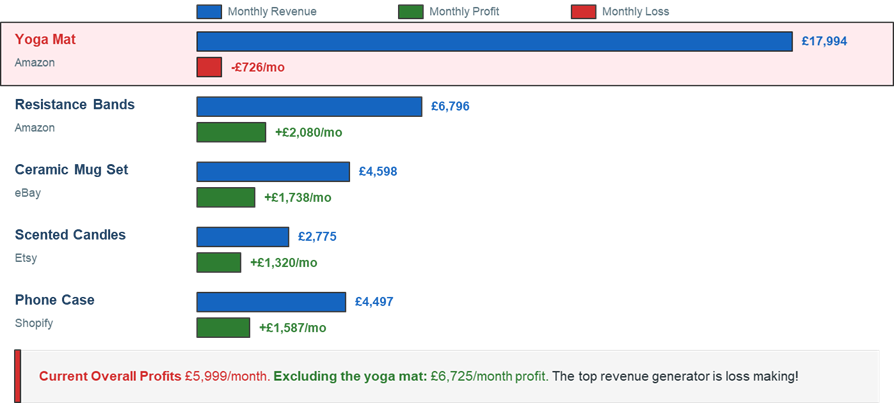
Take five products across three channels. A yoga mat on Amazon at £29.99 sells 600 units a month — nearly £18,000 in revenue, the top performer on every dashboard. But it’s heavy (expensive fulfilment), competitive (high advertising), and has an 8% return rate. Total fees per unit: £19.20. Cost of goods: £12. Real margin: minus £1.21 per unit. That’s £726 a month in losses on the business’s “best” product.
Meanwhile, resistance bands on Amazon (400 units, £16.99) contribute £2,080 a month — light, organic ranking, barely returned. A ceramic mug set on eBay (200 units, £22.99) contributes £1,738 with lower platform fees. Scented candles on Etsy add £1,320 and a phone case on Shopify adds £1,587. Without the yoga mat, this business makes £6,725 a month. With it, that drops to £5,999. The top revenue generator is actively dragging the business down.
Once you have this data, the decisions become obvious. Discontinue the yoga mat or raise the price until the margin turns positive. Shift freed-up ad budget into the resistance bands where every pound comes back with profit. And check whether the yoga mat works on Shopify where there’s no referral fee — a product that loses money on one channel can be profitable on another.
This is the question behind every frustrated comment: “I’m doing £30,000 a month in sales and I’ve got nothing to show for it.” The answer is rarely one big leak — it’s dozens of small ones.
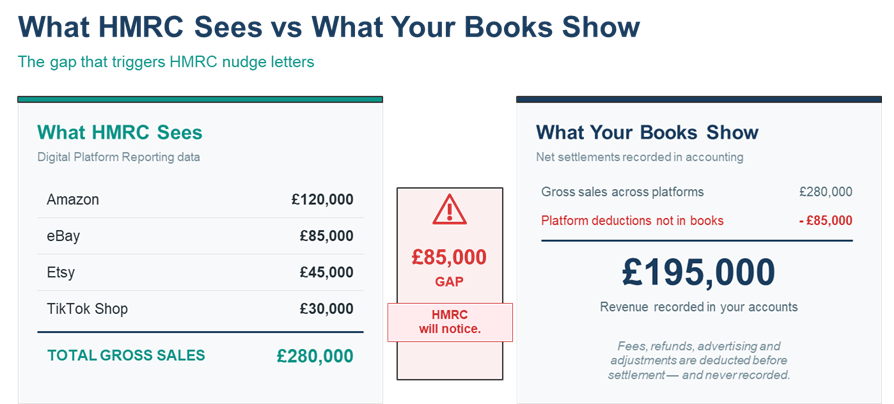
Start with marketplace deductions. A seller doing £30,000 in gross sales might receive £19,000–£21,000 as their settlement. That’s up to £11,000 a month in costs that never appear in your accounts if bookkeeping only records the net settlement figure.
But platform fees are only one layer. Cost of goods fluctuates with every stock order — supplier prices, shipping costs, and currency all move. Payroll is bigger than it looks: a £25,000 salary costs closer to £29,000 after employer’s NIC, pension, and holiday pay — and the 2026 NIC increase widened that gap. Warehouse rent, packaging, software subscriptions, insurance, returns processing — individually small, collectively 15–20% of gross revenue on top of the platform deductions.
The real power comes from categorising these costs and tracking them over time. A single month tells you what you spent. Six months tells you what’s growing, what’s stable, and what’s spiking. Equally important: knowing which costs are fixed (rent, insurance, subscriptions — they hit your account whether you sell one unit or a thousand) and which are variable (platform fees, COGS, fulfilment — they scale with volume). If revenue drops 20%, your variable costs drop with it but your fixed costs don’t. Knowing where that breakeven line sits is the difference between making calm decisions early and discovering the problem when the bank runs dry.
It’s also a compliance issue: your VAT return should be based on gross sales, not net settlements. With HMRC now receiving gross data directly from platforms under the Digital Platform Reporting Rules, that gap will be noticed.
If your turnover grew 25% this year and your profit grew 2%, you worked significantly harder for almost no extra reward. This is one of the most common traps in ecommerce — scaling revenue while margins quietly shrink.
It happens gradually. Amazon increases FBA fees by 3%. Your supplier raises prices by 5%. You increase ad spend to maintain visibility. You hire a part-time packer. Over six to twelve months, a product making £5.20 per unit is now making £2.80 — and without margin tracking over time, you won’t notice until the bank balance tells you.
The question isn’t “am I profitable” — it’s “am I more or less profitable than six months ago, and why?” That means comparing this quarter versus last, by product, channel, and cost category. When you can see your overall margin dropped from 22% to 16% and identify that two thirds came from advertising and one third from supplier increases, you have something to act on. Without that trend data, you just have a vague feeling that things are tighter than they used to be. This is also how you spot the inflection point where the next £100,000 in revenue costs more to generate than the last — because it requires more advertising, more stock, more staff, and more warehouse space.
But profitability on paper isn’t enough on its own — you also need to know whether that profit is turning into cash. A business can show improving margins and still run out of money. If your profit growth is funded by doubling stock orders, that margin improvement is locked up in inventory for 90–120 days (see Question 1). The businesses that thrive track both: is the margin getting better, and is the cash following?
In 2026, compliance risk for ecommerce sellers is coming from two directions at once.
First, Digital Platform Reporting. Amazon, eBay, Etsy, TikTok Shop and other marketplaces now report your gross sales directly to HMRC every year. If those numbers don’t match your tax return, you’ll get a nudge letter — and these have been landing in increasing volumes since late 2024. The sellers most at risk: those recording net settlements instead of gross revenue, those who’ve exceeded the £90,000 VAT threshold across multiple channels without realising, and those without consolidated reporting.
Second, Making Tax Digital for Income Tax went live on 6 April 2026. Sole traders and partnerships with income above £50,000 must now submit quarterly digital updates. MTD requires a complete “digital link” from source data to HMRC — manual copy-pasting from marketplace reports into spreadsheets is now a compliance breach.
Getting compliance right doesn’t just avoid penalties — it puts money back in your pocket. Proper reconciliation often reveals VAT overpayments from double-counted marketplace VAT. If you import goods, matching customs entries against HMRC’s C79 certificates typically recovers thousands annually in unclaimed Import VAT. And an annual VAT scheme review can produce genuine savings. Compliance done properly is a profit centre, not just a cost.
If you can answer all five with confidence, you’re in a strong position. If you can’t answer three or more, that’s not a criticism — it’s a signal that the financial infrastructure behind your business needs attention before the next growth phase, the next VAT return, or the next time HMRC cross-checks your numbers.
At Grosvenor.Solutions, these five questions are at the core of what we do for ecommerce clients. We connect directly to your marketplace platforms and accounting software, and our AI financial analyst, Chloe-AI, works across your sales channels 24/7:
We don’t just file your returns and send a P&L once a quarter. We give you the tools to understand your numbers in real time. If any of these five questions gave you pause, we should talk.
A 15-minute call where we’ll review how your current setup handles these five areas and identify any gaps — whether you work with us or not.
➤ Book Your Free Audit at grosvenor.solutions/discovery-meeting.