Why most businesses in the UK fail — And how Cashflow forecasts helps prevent it.
Why do most businesses in the UK fail? It’s not competition. It’s not a bad product. It’s not poor marketing and many other factors most people will say has caused a business failure. The reasons are logical, but they are not what kills a business. Think about it.
A business fails when it can no longer meet its obligations – when it can no longer pay suppliers, can’t make payroll, can’t settle the VAT bill, can’t cover the rent etc. This is insolvency. And insolvency is a cash problem.
So as hinted in the blog title most businesses fail due to Cash – not having enough cash to meet their obligations. Don’t get me wrong bad products, poor marketing and other factors are not being condoned, they often do contribute to lack of cash, but the direct cause of failure is cash
The Profits / Cash Fallacy
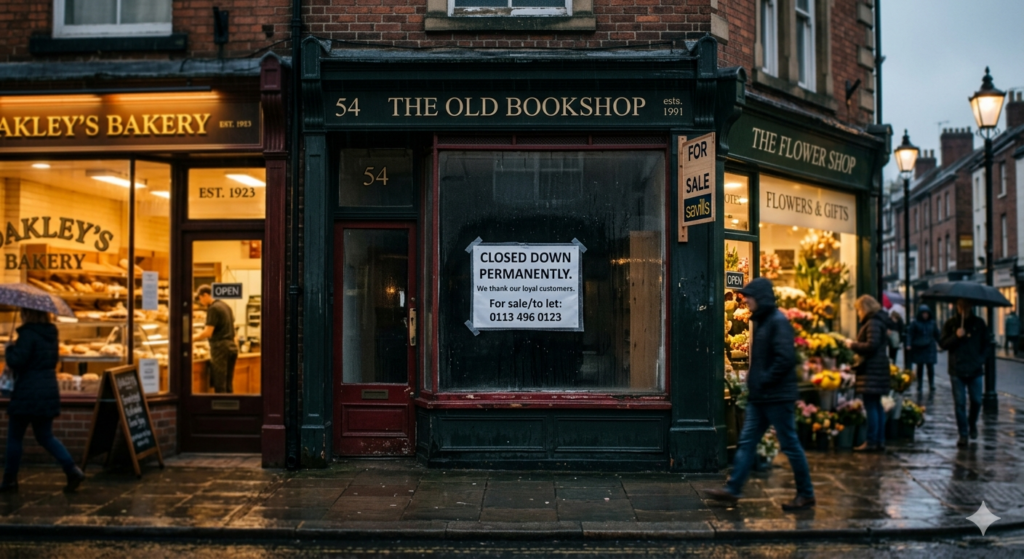
All too often many business owners equate business profits to Cash. This is wrong and very dangerous. Many profitable businesses fail due to cash. Let’s address the difference between profits and cash with a simple example.
In January 2026, a business had sales of £100,000 that were made on a 60-day credit term. It had total expenses of £40,000 (in the month) which included payroll costs of £10,000 and rent of £4,000 which it had to pay in January. At the start of January, the business had £5,000 in its bank account.
In your accounts, profits are based on when revenue is earned and expenses are incurred (ie, not when cash exchanges changes hands), so in our example profits for January will be reported as £60,000 (ie, £100000 of sales less the £40,000 total expenses). But you can see the profits and cash balances tell very different stories. The profits look great but he cash position is dire!
The business had £5,000 in its bank account at the start of January, did not receive any cash from its January sales, and must pay its payroll and rent costs that total £14,000. So, the business is technically insolvent – it has a cash shortfall of £9,000 in January being the shortfall of £14,000 for January and the money it had in the bank account at the start of January, ie, £5,000.
Many business incorrectly use their profit figures and accounts to “manage” their ability to meet their obligations – profits and your business accounts are not based on when cash changes hands, and also they are backwards-looking; you cannot ensure future cash availability to meet future obligations by solely concentrating on the past.
What a Cash Flow Forecast Actually Does
A cash flow forecast is a projection of your incoming and outgoing cash over a future period. It takes everything you know — invoices due, bills to pay, recurring costs, tax deadlines — and lays it on a timeline so you can see your expected bank balance at any point ahead.
No forecast is 100% accurate. A customer might pay late. An unexpected cost might appear. But a forecast doesn’t need to be perfect. It needs to be close enough to act on. If it shows week 9 will be tight and reality hits in week 10, you’re still far better placed than the owner who didn’t know either week was a problem because you will have taken action to mitigate the week 9 crunch will be of relevance to the actual shortfall in week 10.
Characteristics of good cashflow forecasts.
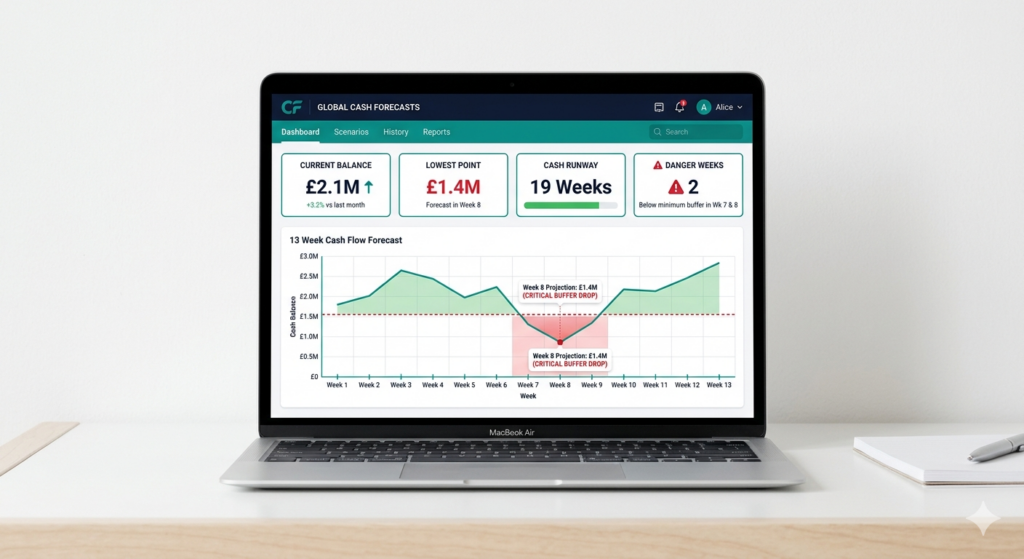
Businesses should maintain both short-term and long-term cash flow forecasts. A good forecast is connected to your live financial data — your invoices, bills, bank balances, and payment history — updating automatically as your position changes. I also recommend the use of a minimum cash buffer, so your forecast doesn’t just tell you when you’ll run out of cash — it tells you when you’re getting dangerously close. The buffer amount will vary by business depending on factors like turnover, overhead volatility, and payment cycle length, but as a rule it should be enough to cover the largest unforeseen bill that could realistically land in any given week.
Short-term Vs Long-term Cash Flow Forecasts
Businesses need both Short and long-term forecasts. Short term forecasts keeps the business solvent whilst long-term forecasts helps businesses grow in a sustainable manner.
Short-term Forecasts
Short-term forecasts (13 weeks/3 months) are built from actual invoices and bills, so they’re highly precise. They answer operational questions: can I make payroll? Which invoices do I need to chase this week? Should I delay that equipment purchase?
Short-term forecasts are used for liquidity management – making sure you have enough cash to pay what you owe on its due date. It answers the question will I run out of cash in the next quarter and where this is indicated gives businesses the opportunity to take corrective actions to mitigate against it.
Long-term Forecasts
Longer-term forecasts (12 months to 3 years) use historical trends and seasonal patterns. Less precise, but they answer strategic questions: can I afford to hire next quarter? Will I survive a quiet winter? Do I need external funding, and when?
Long-term forecasts are primarily for strategic planning – informing on decisions about growth, sustainability and investment. Longer term forecasts by their very nature are less precise than a short-term forecast. However, for long term forecasts we can see the trajectory and direction of cash flow.
What Changes When You Can See Ahead (ie, when you forecast your cash flow)
1. You shift from “Firefighting” to “Tactical Maneuvering”
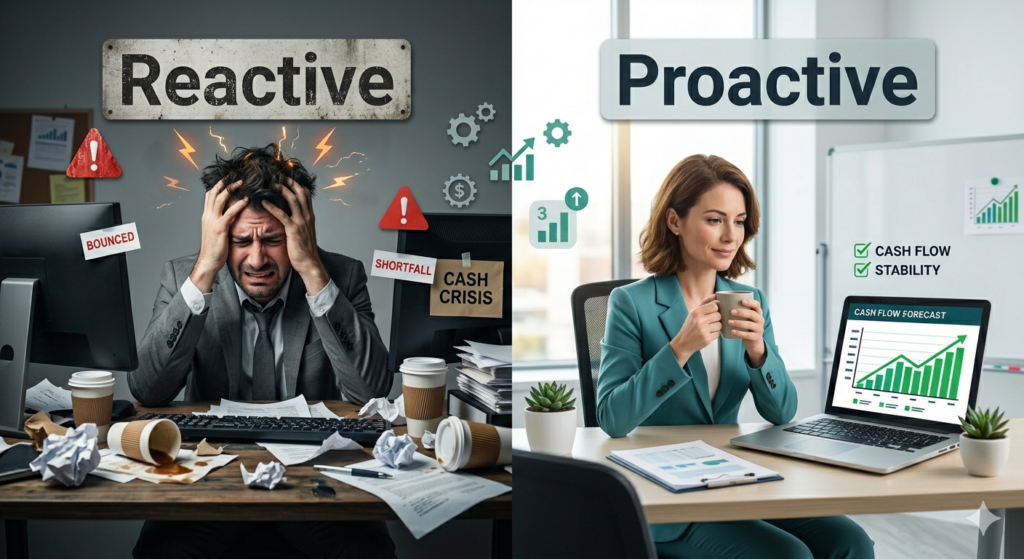
The most immediate benefit is the elimination of the “Monday Morning Surprise.” Without a forecast, you only react when a payment fails or cannot be met. In 2026’s high-speed payment environment, that delay is often fatal.
2. You de-risk “Overtrading” during growth
Paradoxically, many businesses fail not because they are losing money, but because they are growing too fast. Growth requires an immediate cash outlay for stock, tech, and talent, while the revenue often lags by months.
A forecast makes this “cash gap” visible before you commit to the expansion. It allows you to stress-test your growth: if you win that big contract, can your current reserves bridge the 60-day gap until the first payment lands? Forecasting ensures you scale at a pace your bank balance can actually support, rather than “growing yourself into bankruptcy.”
3. You secure better funding on better terms
Banks and investors in 2026 have moved toward data-driven, real-time underwriting. They don’t just want to see that you have cash; they want to see that you understand why it’s there and where it’s going.
Approaching a lender when your account is near zero makes you a “distressed borrower,” which leads to higher interest rates or flat-out rejection. Approaching them three months ahead of a projected need—with a forecast that shows exactly how the loan will be used and repaid—positions you as a low-risk, high-control partner. You negotiate from a position of strength, not desperation.
4. You optimize “Idle Cash” and Working Capital
Having too little cash is a crisis, but having too much sitting idle in a current account can be a missed opportunity. In a volatile interest rate environment, every pound needs to be working.
A forecast reveals when you’ll have a surplus. This allows you to make strategic moves: paying a supplier early to snag a “settlement discount,” investing in high-yield short-term instruments etc. It turns your bank balance from a passive pool into an active tool for increasing your margins.
5. You replace “Financial Anxiety” with “Operational Clarity”
Financial stress is rarely about the numbers; it’s about the uncertainty of the numbers. SME leaders who don’t forecast spend significant mental energy “mental-mathing” their way through the month.
A forecast provides a “single source of truth.” It doesn’t make hard months disappear, but it does make them predictable and actionable. When you can see the next 13 weeks clearly, you stop treating every outgoing spend as a threat and start treating them as scheduled tasks.
Spreadsheets May Not Save You Either
If you’ve tried forecasting before, it probably involved a spreadsheet. The problem isn’t accuracy — it’s staleness. A spreadsheet isn’t connected to your accounting system, so it starts going wrong the moment you create it. Spreadsheets need someone to maintain them: this can be a huge effort for cashflow forecasting.
In practice, this means the spreadsheet forecast may get updated when things are calm and there is plenty of spare time, but conversely they tend to get neglected when the business is busy or in chaos – the forecast is least reliable precisely when you need it most because it is not updated due to the immense effort this requires.
As earlier mentioned, what businesses need is a forecast that can updates itself — one that connects to real invoices, real bills, and real bank balances, recalculating every day without anyone opening a spreadsheet – no excel gymnastics.
How We Approach This at Grosvenor.Solutions
At Grosvenor.Solutions, cash flow forecasting is built into every client relationship. Not as an add-on. Not as a separate subscription. Because it’s too important to be optional.
You get a 13-week short-term forecast built from your actual invoices, bills, and tax obligations, using customer-specific payment behaviour — how long your customers take to pay, not an industry average. It updates nightly from your Xero or QuickBooks.
You get a long-term view out to three years based on your historical trends and seasonal patterns, so you can plan hires, investments, and quiet periods months ahead.
You get scenario planning — model what happens if your biggest customer delays payment, if you hire, if revenue drops. Up to five scenarios overlaid on the same chart.
And because this sits inside your accounting relationship, you don’t just get a chart. Your accountant interprets the forecast, identifies risks, and presents options with financial implications. That’s the difference between a tool and a service.
Three Things You Can Do This Week
You don’t need software to start. These three steps cost nothing and take an hour.
- Find out when your customers actually pay. Not the terms on your invoices — the real average. If you invoice at 30 days but the average is 47, your mental model of cash is wrong by over two weeks. Check your accounting system for the actual numbers.
- Map every committed outgoing with its exact date. Rent, payroll, pension, insurance, subscriptions, loan repayments, and every tax deadline with an estimated amount. Amounts matter; dates matter more.
- Start thinking in uncommitted cash. £50,000 in the bank sounds comfortable until £35,000 of it is committed to payments in the next 10 days. Your real position is £15,000. Train yourself to see through the headline number.
The Question You Should Be Asking
Businesses fail when they run out of cash. Cash runs out when commitments arrive that you didn’t see coming and cannot meet. A forecast shows you what’s coming so you can navigate your way around potential pot holes.
Your accounts and reported profits do not do this. Your bank balance can’t do this — it tells you where you are, not where you’re heading.
The question isn’t whether you can afford to forecast your cash flow. It’s whether you can afford not to.