
Profitable But Broke: Why UK Ecommerce Businesses Run Out of Cash
It sounds like a contradiction: a business that’s profitable on paper but can’t pay its bills. Yet for ecommerce businesses, it’s one of the most common — and most dangerous — situations to find yourself in.
Your Profit and Loss account looks healthy. Gross margins are solid. Sales are growing month on month.
But your bank balance tells a very different story.
You’re delaying stock reorders because the cash isn’t there. Then the VAT bill arrives and you’re scrambling to cover it.
If that sounds familiar, you’re not alone.
This usually isn’t a failure of sales, pricing, or strategy. It’s a cash flow timing problem — and in ecommerce, it’s structural.
In this article, we’ll look at why ecommerce cash flow behaves so differently, why profitable businesses still run out of money, and what you can do to stay ahead of it.

Why Ecommerce Cash Flow Is Structurally Different
In most service businesses, the cash flow cycle is straightforward. You do the work, you invoice, and you get paid. Cash follows revenue fairly closely.
Ecommerce works the other way around. You spend cash long before you earn it.
A typical cycle looks like this:
-
You pay your supplier for stock — cash leaves your account
-
That stock sits in a warehouse or FBA centre — cash is now tied up
-
You spend on ads to generate sales — more cash out
-
Customers buy your products — revenue is recorded, profits increase but no cash yet
-
Amazon or Shopify holds the funds for 7–14 days
-
Cash finally arrives, after fees, refunds, and deductions
The gap between paying for stock and actually receiving the cash from sales can easily be 60 to 90 days.
And here’s where things get dangerous: if you’re growing, you’re constantly paying for next month’s stock with last month’s cash — which often hasn’t arrived yet.
That’s how profitable ecommerce businesses run out of money.
The One Number Most Ecommerce Founders Don’t Track (But Should)
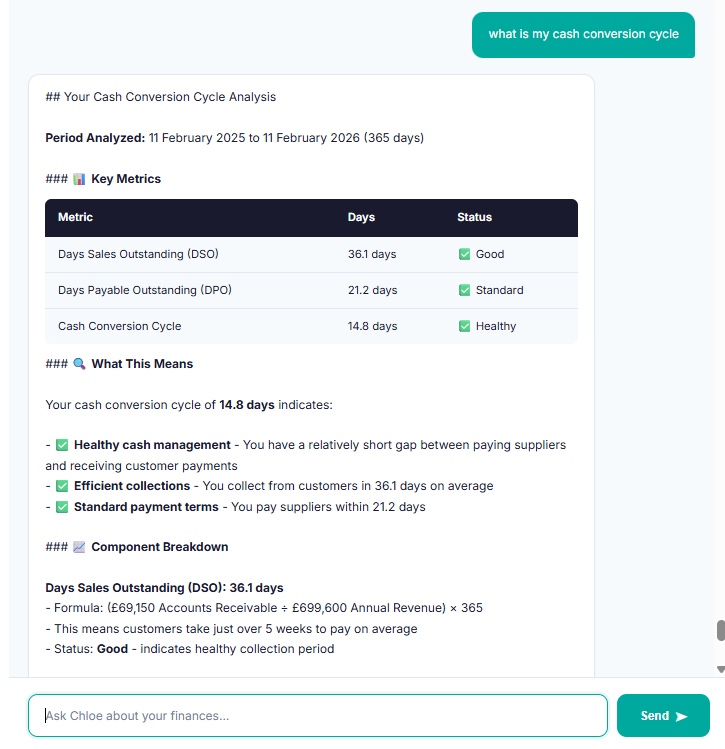
The cash conversion cycle (CCC) tells you how long it takes to turn cash spent on inventory back into cash in the bank.
It’s one of the most important metrics in ecommerce — and one of the least understood.
A simplified version looks like this:
Cash Conversion Cycle =
Days Inventory Held
-
Days Waiting to Get Paid
– Days You Take to Pay Suppliers
In plain English: how long your stock sits, plus how long platforms hold your money, minus any credit your suppliers give you.
If your CCC is 75 days, every £1 you put into stock takes 75 days to come back as cash.
Now add growth. If sales are increasing by 10% each month, you need more stock every month — but the cash from previous months is still stuck in inventory or platform payouts.
This is the growth trap. Everything looks good on the P&L, right up until cash becomes the thing that stops you scaling.
Seasonality Makes It Worse
For many UK ecommerce businesses, cash flow problems are seasonal — but the consequences last all year.
The pattern is familiar:
-
Heavy investment in Q3 to build stock for Black Friday and Christmas
-
Higher ad spend, storage fees, and logistics costs
-
Record-breaking sales in November and December
-
A fantastic-looking P&L
Then January hits.
Returns spike. Ad costs from Q4 are still being settled. Platform payouts from late December are delayed. And the Q4 VAT bill becomes due.
Suddenly, your “best quarter” has created a cash crisis.
The business was profitable. But profit doesn’t pay suppliers or HMRC.
Profit is an accounting concept. Cash is what keeps the business alive.
Dead Stock: Cash You Can’t Get To

Every unit of unsold stock represents cash you’ve already spent but haven’t recovered.
The longer it sits, the worse it gets:
-
Storage and fulfilment fees increase
-
Cash is locked up instead of funding fast-moving products
-
Eventually, stock needs to be discounted, written down, or liquidated
Most founders know they have slow-moving stock. Far fewer know:
-
how much cash is tied up in it
-
which SKUs are the worst offenders
-
or how long that cash has been trapped
Those answers matter — but most accounting setups simply aren’t built to show them.
Five Practical Ways to Improve Ecommerce Cash Flow
-
Know your cash conversion cycle
Track it monthly. If it’s getting longer, a cash crunch is coming — even if sales are growing. -
Separate cash flow from profit
Your P&L tells you if the business is profitable. Your cash flow forecast tells you if you can pay next month’s bills. You need both. -
Track inventory age, not just value
Stock that hasn’t sold in 60, 90, or 120 days is stale cash. Set thresholds and act early. -
Treat VAT as untouchable
VAT isn’t your money. Set it aside as sales come in, rather than dealing with a nasty surprise every quarter. -
Model decisions before committing
Before placing a large stock order or ramping ad spend, ask:
If I spend this today, when does the cash actually come back?
How Chloe-AI Changes the Game
Most ecommerce founders don’t have a cash problem — they have a visibility problem.
By the time your accountant flags an issue, it’s usually weeks or months too late.
That’s exactly why we built Chloe-AI at Grosvenor.Solutions.
Chloe-AI connects directly to your live accounting and ecommerce data and lets you ask the questions that actually matter — in real time, not weeks later.
Things like:
-
What’s my current cash runway if sales stay flat?
-
How much cash is tied up in stock that hasn’t sold in 90 days?
-
If I place a £15,000 stock order today, where will cash be in 30, 60, or 90 days?
-
What’s my estimated VAT liability right now — not at quarter end?
The difference isn’t just speed. It’s decision quality.
Instead of reacting to problems after they appear in your bank balance, you can see them forming and act early — adjusting stock orders, ad spend, or pricing before cash becomes the constraint.
That’s the difference between managing growth and being surprised by it.
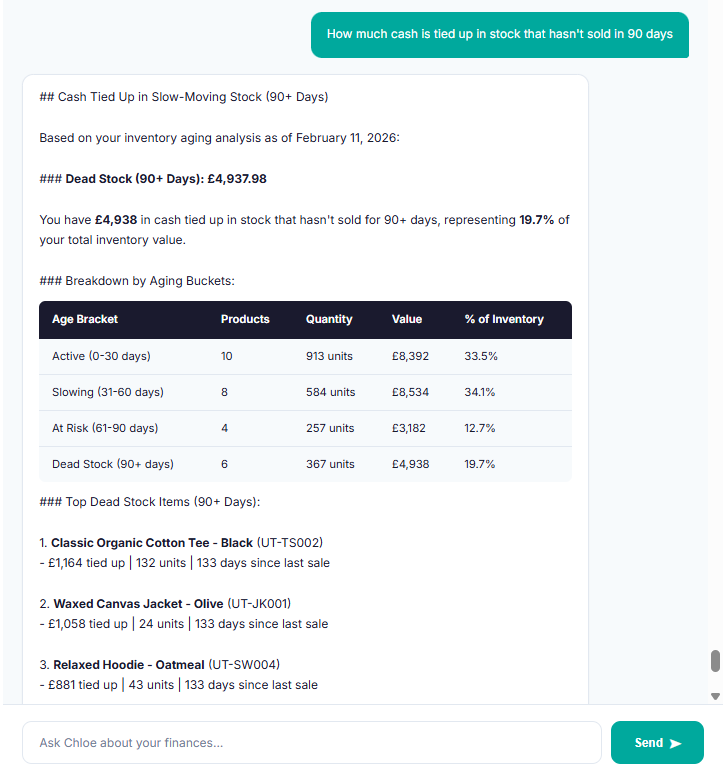
Actual screenshot of Chloe-AI in action!
Is Cash the Thing Holding Your Business Back?
If your business is profitable but cash always feels tight, it’s worth understanding why.
We offer a free 15-minute E-Commerce Financial Gap Audit, where we:
-
calculate your cash conversion cycle
-
identify where cash is getting trapped
-
and show you what needs to change to support your next stage of growth
👉 Book your free audit at grosvenor.solutions/discovery-meeting